ADHD and Anxiety: Why They Often Go Together and What Can Help


Ever feel like your brain has 27 tabs open at once - they’re all demanding your attention but your mind refuses to tell you which one to deal with first?
You might constantly worry about forgetting something, missing an important detail or being late.
You know you need to get things done, but somehow starting a simple task can feel ridiculously difficult.
Then you've got deadlines looming, the pressure is building and suddenly your brain kicks into gear.
You might also find yourself overthinking conversations, replaying mistakes, worrying you've forgotten something or struggling to switch off at night.

For many people with ADHD, feeling overwhelmed, distracted or unable to switch off can go hand in hand with anxiety.
And sometimes it can be difficult to work out where ADHD ends and anxiety begins, because some of the experiences can overlap.
So why do ADHD and anxiety so often seem to turn up together?
And what’s actually going on in the brain?
In this blog, we're going to look at the connection between ADHD and anxiety, what ADHD can look like, why certain ADHD traits can make anxiety more likely, and some of the things that can help.
What is ADHD?
ADHD stands for Attention Deficit Hyperactivity Disorder. It is a neurodevelopmental condition, meaning it relates to the way the brain develops and functions.
ADHD isn’t simply about being distracted or hyperactive. It involves differences in the way the brain manages things like attention, motivation, impulse control and executive functions such as planning, working memory and organisation.
ADHD is generally described in terms of three core areas:
Inattention
Hyperactivity
Impulsivity
Not everyone with ADHD experiences all three in the same way, and the way these characteristics show up can vary considerably from person to person.
ADHD can affect children, teenagers and adults, and symptoms need to have been present from childhood, even though someone may not receive a diagnosis until much later in life.
It is also worth remembering that ADHD doesn’t mean that an individual can’t concentrate.
In fact, many people with ADHD can concentrate incredibly well when something is interesting, rewarding or stimulating. The difficulty can be regulating attention and directing it towards something that feels boring, repetitive or where the reward isn't immediate.
So someone might spend three hours completely absorbed in something they love, but struggle to start a 15-minute admin task.
And this in itself can be incredibly frustrating.
What can ADHD look like?
ADHD can look very different from one person to another.
For some people, it may be more obvious. They may be restless, talkative, impulsive, interrupt conversations, act quickly without thinking things through or struggle to sit still.
For someone else, ADHD may be much less visible.
They might:
Frequently lose or misplace things
Forget appointments or tasks
Struggle with time management
Procrastinate even when something is important
Find it difficult to prioritise
Become overwhelmed by a long to-do list
Start lots of things but struggle to finish them
Become easily distracted
Experience racing thoughts
Struggle with working memory
Find transitions between tasks difficult
Experience periods of intense focus on something interesting
Become frustrated or emotionally overwhelmed more quickly
Struggle to regulate their attention and energy
Find everyday organisation surprisingly exhausting

Not all of these experiences are part of the formal diagnostic criteria for ADHD. However, difficulties with executive functioning and emotional regulation are commonly reported and research suggests that these areas are closely connected.
ADHD can also be less obvious in some people. Women and girls, for example, may be less likely to show the more noticeable hyperactive or impulsive behaviours traditionally associated with ADHD. Instead, they may spend a huge amount of effort trying to stay organised, keep on top of everyday demands or manage feelings of overwhelm. (You can read more information in the tab at the bottom of this blog).
The impact can extend well beyond attention and concentration. When everyday tasks require more effort, things are frequently forgotten or plans don't go as expected, it can affect how you feel about yourself and how you approach everyday life.
Over time, experiences like these can also create fertile ground for anxiety.
The relationship between ADHD and anxiety
ADHD doesn't automatically cause an anxiety disorder.
However, some of the difficulties associated with ADHD can create circumstances that make anxiety more likely to develop or stick around. Research also shows that anxiety symptoms are more common in adults with ADHD, although the relationship between the two is complex.
Think about your brain's executive functions as the management team responsible for organising the day. This includes planning, prioritising, remembering, starting, stopping and switching between tasks, keeping track of time and regulating your response to things.
For someone with ADHD, some of these processes can be more difficult.
Then add in all the every day life ‘stuff' like emails, work deadlines, appointments, bills, housework, relationships…
Remembering where you put your keys…
Remembering why you walked into the kitchen…
Remembering the thing you were supposed to remember five minutes ago (just me?!)…
You can see how the brain might start to feel as though it is constantly playing catch-up.
Living with ADHD-related difficulties can create circumstances that make anxiety more likely to develop or become more persistent.
What happens in the ADHD brain?
This is where the neuroscience gets particularly interesting.
Your brain is constantly receiving information and deciding what deserves your attention, what can wait and what can be filtered out.
The prefrontal cortex, towards the front of the brain, plays an important role in this. It helps with things like attention, planning, working memory, decision-making and regulating behaviour and emotions.
Then there are areas such as the amygdala, which help detect things that might be important or threatening.
You can think of the amygdala a little like your brain's notification system. It flags things that might need your attention, while other brain networks help you decide what to focus on.

With ADHD, research suggests there can be differences in the brain networks involved in attention, executive functioning, reward and emotional regulation.
It’s not as simple as saying that one part of the brain is ‘switched off’ or another is permanently overactive. The brain is much more complicated than that.
These differences can affect how easily attention is captured, and how difficult it can be to direct and sustain that attention when something isn’t particularly interesting or rewarding.
Something new, interesting or emotionally significant can grab your attention very quickly. But a repetitive or less stimulating task can feel surprisingly difficult to start, focus on or stick with.
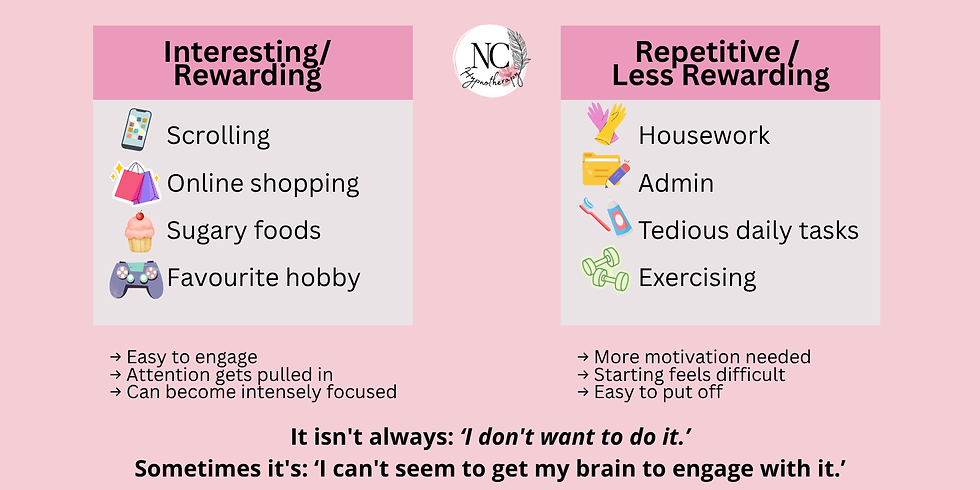
That's one reason someone with ADHD might be able to spend hours completely absorbed in something they're interested in, but struggle to start a 15-minute task they've been putting off.
Where do dopamine and noradrenaline come in?
Dopamine and noradrenaline are neurotransmitters, which means they help different parts of the brain communicate with each other. Both are involved in brain networks that support attention, motivation, learning, reward, impulse control and executive functioning.
Research has found differences in several of these brain networks in people with ADHD, including networks involving the prefrontal cortex and striatum, which are important for things like attention, motivation, planning and impulse control.
You may have heard ADHD described as a 'dopamine deficiency,' but that's an oversimplification. It's more accurate to say that dopamine signalling appears to work differently in ADHD, alongside differences in noradrenaline signalling and the brain networks these neurotransmitters support.
Dopamine is often called the brain's 'reward chemical,’ although that's a very simplified way of describing it. It's involved in motivation, learning, attention and helping the brain work out what is important or rewarding.
This may help explain something that can feel particularly frustrating with ADHD: being able to become completely absorbed in something interesting or rewarding, such as scrolling on your phone or online shopping, while finding a repetitive or less stimulating task, like housework, incredibly difficult to start.
It's not necessarily, 'I don't want to do this.'
It can be more like, 'I know I need to do this, but getting my brain to engage with it is proving really difficult.'
That's an important distinction.
What looks like procrastination or a lack of effort from the outside can sometimes involve differences in motivation, attention and executive functioning.
This is also one reason ADHD medication can help some people. Different medications work in different ways, but many affect dopamine and/or noradrenaline signalling, helping to support the brain networks involved in attention and self-regulation.
When ADHD and anxiety create a vicious cycle

Our brains are very good at learning patterns. If a particular sequence of events repeatedly ends with getting the job done, your brain can start relying on that pattern.
This doesn't mean you are lazy or incapable of managing your life. It means your brain may have learned to rely on urgency and stress to generate the activation needed to get something done.
Anxiety is very good at providing urgency. This comes in handy when there's an actual emergency.
But it’s not so useful when the 'emergency' is an email you've been avoiding for three days.
Why can people with ADHD overthink so much?
A common question I get in my practice is: 'Why does ADHD cause me to overthink everything?'
ADHD and overthinking can certainly coexist.
Difficulty regulating attention doesn't mean there are no thoughts. Sometimes there can be A LOT of them.
You might replay conversations (more about this in my blog here), worry about whether you've upset someone, think through every possible outcome, jump between different worries or find that your brain keeps returning to a mistake you made earlier in the day.
There can also be a connection between ADHD-related difficulties and anxiety.
If you've repeatedly forgotten things, missed deadlines, struggled with organisation or been told that you are 'not trying hard enough,’ you may start anticipating that something will go wrong.
The brain is constantly using previous experiences to help predict what might happen next.
So if you've experienced a few situations where you forgot something, arrived late, missed something important or made a mistake, your brain can start to learn that these things are worth watching out for.
You may find yourself becoming increasingly alert to the possibility of getting something wrong next time, double-checking everything or worrying about what you might have missed.
And that constant anticipation of the next mistake can, in turn, feed anxiety.
ADHD, rejection sensitivity and social anxiety
You may have come across the term ‘rejection sensitivity’ when reading about ADHD. While it isn't part of the formal diagnostic criteria for ADHD, some people with ADHD describe experiencing criticism, perceived rejection or social mistakes particularly intensely.
If you've spent years feeling as though you're always getting things ‘wrong’, being told you're too much, too forgetful, too disorganised or simply not trying hard enough, it makes sense that your brain might become more alert to the possibility of getting things wrong again.
This can make social situations feel more mentally exhausting. You might find yourself analysing conversations afterwards, worrying about how someone interpreted something you said, or noticing every little change in someone's tone or behaviour.
And then the thoughts start:
‘Did I say something stupid?’
‘Do they think I'm annoying?’
‘Why haven't they replied?’ ‘
Did I upset them?’
Before you know it, you're replaying a conversation from three days ago at 1am, trying to work out whether you somehow managed to offend someone without realising it.
Over time, this kind of heightened self-monitoring can contribute to social anxiety, particularly if you've learned to expect criticism, rejection or getting things wrong.
Can anxiety look like ADHD?
Absolutely! This is one of the reasons diagnosis can be complicated.
Anxiety can affect concentration, memory, sleep, decision-making and your ability to complete everyday tasks. Some of these experiences can look very similar to ADHD.

That overlap is one reason it can be difficult to work out what's behind certain symptoms. ADHD and anxiety can also occur together.
That is why it is important not to try to diagnose yourself based on an Instagram post, TikTok video or blog article. Even a very relatable checklist cannot tell you what is actually causing your symptoms.
(If you're concerned about ADHD, an assessment with an appropriately qualified professional can help explore the bigger picture.)
How is ADHD managed?
There isn't one single approach to managing ADHD and what helps can look different from person to person.
NICE recommends that ADHD management is tailored to the individual’s needs and circumstances. Depending on the person, this can include medication, therapy, practical strategies and changes to the environment.
There are also some simple strategies that can make everyday life feel a little more manageable. You might find some of these useful:
Externalising reminders
If remembering everything in your head is difficult, don't make your brain do all the work. Calendars, alarms, visual reminders and written lists can take some of the pressure off your working memory and give you something external to refer back to.
Break bigger tasks down into more manageable actions
'Clean the house' is a huge instruction for a brain that’s already juggling lots of information.
'Put the washing on’ or ‘Clear the kitchen work top’ is much more specific and easier for the brain to process and get started with.
Breaking a task down into one small, clear action can make it feel less overwhelming.
Reduce unnecessary decisions
Simple routines can be surprisingly helpful. Having a regular place for your keys, a set morning routine or deciding what you're having for breakfast before the day starts can reduce the number of decisions your brain has to make.
Think about your environment
Some people concentrate better with background noise, music, movement or something to fidget with. Others need quiet and fewer distractions.
There isn't a perfect ADHD-friendly environment. It's about noticing what helps your brain focus and making your surroundings work with you rather than against you.
Prioritise the basics
Sleep, regular meals and movement matter for everyone, but they can be particularly helpful when you're already dealing with difficulties with attention, emotional regulation or stress.
You don't need a perfect routine. Small, consistent habits can make it easier to manage the demands of everyday life.
Don't forget about anxiety
If anxiety has become part of the picture, it may need its own support. Managing ADHD doesn't necessarily mean that anxiety will automatically disappear, particularly if you've developed patterns of overthinking, worry or avoidance alongside it.
Understanding what's contributing to the anxiety can therefore be an important part of the bigger picture.
How I work with people with ADHD and anxiety as a Clinical Hypnotherapist
Firstly, let’s highlight something important: ADHD isn't something I diagnose.
My role is to work with the difficulties you want support with, rather than trying to determine whether you have ADHD.
I regularly work with adults and teenagers who have a formal ADHD diagnosis, as well as people who suspect they may have ADHD and/or are exploring assessment or support.
My previous career as a teacher, including working with children and teenagers with a wide range of additional needs, has given me a lot of experience of seeing how attention, organisation, overwhelm, confidence and anxiety can present differently from person to person.
That experience is particularly useful when working with teenagers because ADHD doesn't exist in isolation from school, friendships, exams, expectations and the general chaos of being a teenager. (And when you add hormones to the mix, that's a whole load of petrol being added to the fire!)
Adults can also face their own version of that chaos with work, family life and the other 47 things you're apparently supposed to remember before lunchtime.
When ADHD and anxiety overlap, I'm not trying to turn you into a perfectly organised human who never forgets anything. (I'd have some of that myself if it were possible!)
The focus is on helping you understand what contributes to the overwhelm and anxiety, find strategies that work for you and develop more helpful ways of responding when things feel difficult.
How can Solution Focused Hypnotherapy help with ADHD and anxiety?
Solution Focused Hypnotherapy doesn’t treat or cure ADHD, and it isn't a replacement for an ADHD assessment or medical treatment.
It can, however, support some of the difficulties that can sit alongside ADHD, particularly anxiety, overwhelm, overthinking, stress, low confidence and sleep difficulties.
Solution Focused Hypnotherapy combines solution-focused psychotherapy with hypnosis and draws on our understanding of how the brain responds to stress and threat.
Rather than spending lots of time analysing everything that has ever gone wrong, we focus on what is working for you, what you want to be different and the practical steps that can help you move towards it.
Depending on what you're struggling with, this might involve learning to:
Recognise when your brain is becoming overloaded
Respond differently to anxious thoughts
Reduce overthinking and rumination
Manage stress and overwhelm
Build confidence
Improve sleep and relaxation
Develop healthier responses to setbacks
Become more aware of what helps your brain function well
Focus on progress rather than perfection
The goal isn't to 'fix' an ADHD brain. (FYI: Your brain isn't broken.)
It's about finding strategies that work with the way your brain functions, reducing some of the pressure and helping you feel more able to manage the things that currently feel difficult.
If you have ADHD and anxiety, or you're experiencing anxiety and wondering whether ADHD might be part of the picture, you don't have to work it all out on your own.
A good first step is to speak to your GP or an appropriately qualified ADHD professional if you think an assessment may be appropriate.
How common is ADHD in England?
The most recent NHS England estimate, published in 2026, suggests that around 2.49 million people in England may have ADHD, including approximately 741,000 children and young people aged 5–24.
This is an estimate of how many people may have ADHD, rather than a count of people with a formal diagnosis. The Adult Psychiatric Morbidity Survey 2023/24 found that 1.8% of adults reported having received a professional ADHD diagnosis.
These figures highlight an important point: the number of people estimated to have ADHD is considerably higher than the number who have received a formal diagnosis.
ADHD doesn't have one look
When people think about ADHD, they may picture someone who is constantly on the go, unable to sit still, interrupts frequently or acts without thinking.
These can certainly be features of ADHD, particularly when hyperactive and impulsive symptoms are more prominent.
They might include:
Restlessness and difficulty sitting through activities
Interrupting or talking excessively
Difficulty waiting
Acting without thinking
Seeking stimulation
Becoming easily frustrated
But ADHD is much more varied than this stereotype suggests.
Some people are predominantly inattentive. Others experience more hyperactive or impulsive symptoms, while many experience a combination of both. Girls and women can also be highly hyperactive, and boys and men can have predominantly inattentive symptoms.
People of any gender can also develop coping strategies that make their difficulties less obvious to others.
The important point is that ADHD doesn't have one look.
This is one reason it can sometimes go unrecognised, particularly when someone's difficulties don't match the version of ADHD that people expect to see.
ADHD in women and girls
ADHD can look different in women and girls, and this is one reason it may be missed.
Historically, ADHD has often been associated with the stereotypical image of a young boy who cannot sit still, constantly interrupts and gets into trouble at school. (If we were in the same room, you would probably see my eyes literally roll to the back of my head.)
That is only one possible presentation of ADHD, and it can be a particularly unhelpful picture when we are trying to recognise ADHD in girls and women.
NICE highlights that ADHD is thought to be under-recognised in girls and women. They may be less likely to be referred for assessment and more likely to reach adulthood without their ADHD being recognised, or to receive another diagnosis instead.
ADHD in women and girls may be less outwardly obvious, with difficulties such as:
Daydreaming and difficulty staying focused
Forgetfulness and losing things
Difficulties with organisation and time
Perfectionism and people-pleasing
Emotional overwhelm
Anxiety and overthinking
Appearing highly organised while using enormous amounts of mental energy to stay that way
Becoming exhausted or burnt out from constantly trying to keep everything under control
And yes, someone can do well at school and still have ADHD.
Academic success does not automatically rule out ADHD. Some people develop effective coping strategies that hide how much effort things take, such as working much longer than others, relying heavily on lists and reminders, or becoming extremely perfectionistic because making a mistake feels particularly uncomfortable.
From the outside, everything can look completely fine. Internally, it can feel like you are working incredibly hard just to keep up with what seems to come naturally to everyone else.
This can become particularly noticeable in adulthood, when the strategies that once worked start to become harder to maintain alongside work, relationships and the general admin of being a grown-up.
(If this sounds familiar, you can also read more about high-functioning anxiety.)

If anxiety, overwhelm, overthinking, confidence or sleep are the things you'd like support with, Solution Focused Hypnotherapy may be something worth exploring.
If you're based in Essex, I work with adults and teenagers from Hatfield Peverel, Chelmsford, Maldon, Witham, Brentwood, Colchester and surrounding areas, as well as working online with clients across the UK and internationally.
You can book a free, no-obligation 20-minute telephone clarity call to chat about what's going on and whether working together feels like the right fit.


Comments