Fear of Flying: Causes, Symptoms and How Hypnotherapy Can Help You Overcome It

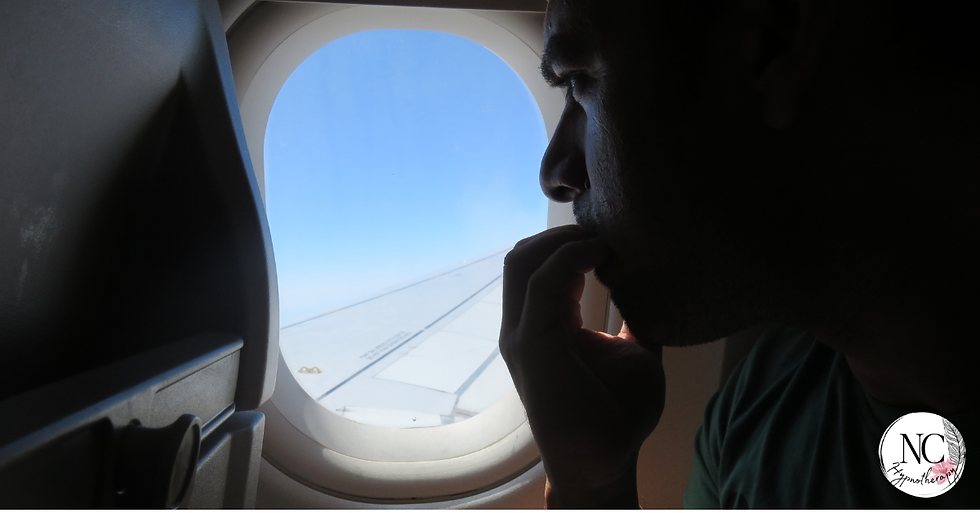
If you feel anxious about flying, experience panic on planes, or the thought of flying makes you avoid booking flights altogether, you are far from alone.
Fear of flying (also known as aerophobia or flight anxiety) is far more common than most people realise. In fact, around 25–30% of adults experience some level of anxiety when flying, and around 6–7% experience a clinical level of fear that can lead to avoiding flights altogether.
For some, it’s a sense of unease before take-off. unease. For others, it can mean missed holidays, turning down opportunities or feeling limited in where life can take them.
The important thing to understand is this: this fear isn’t a sign that something is wrong with you. It is your brain trying to protect you.
What is Fear of Flying?
Phobias are generally grouped into two categories: specific phobias and complex phobias.
Specific phobias relate to a specific object, situation or animal. Examples of this may be dogs (cynophobia), spiders (arachnophobia) or clowns (coulrophobia). The fear is triggered by something clearly defined.
Complex phobias, on the other hand, tend to be more wide-ranging and can affect multiple areas of life. Examples of these are social anxiety, fear of enclosed spaces (claustrophobia) or fear of sick (emetophobia).
(For more information about phobias and how Hypnotherapy can help, you can check out this blog.)

Fear of flying falls under the category of a specific phobia. This means that the brain has created an intense fear linked to a particular situation, even when the actual level of danger is very low.
Why Logic Alone Does Not Switch Flying Anxiety Off
Most people with a fear of flying already understand the facts.
You might know that statistically, flying is one of the safest forms of transport. In reality, you are far more likely to be involved in a road traffic accident than anything happening in the air.
And yet, your body can still react strongly. You might notice waves of anxiety, a sense of dread, or that familiar build-up of tension, sometimes even before you have stepped onto the plane.
You may have tried to push through it, telling yourself to stay calm or to think rationally.
But this is where it can feel frustrating.
Because the reaction you are experiencing is not being driven by logic. It is coming from the part of the brain responsible for keeping you safe.
And that part of the brain works quickly and automatically. Which means this is not something you can simply think your way out of.

What’s Happening in the Brain When It Comes to Flight Anxiety?
To understand why the fear feels so powerful, it helps to look at how the brain processes situations.
There is a more primitive part of the brain whose role is to keep you safe. It’s constantly scanning for anything unfamiliar, unpredictable, or outside of your control. Flying tends to tick all of those boxes.
You’re in an enclosed space.
You’re not the one in control.
The sensations are very different from everyday life.
Changes in altitude, turbulence, unfamiliar sounds.
All of this can be interpreted by the brain as potential danger.
A helpful way to think about it is like a smoke alarm.
It is designed to go off at the first hint of danger, not when danger is confirmed. For some people, that alarm becomes a little over-sensitive and starts reacting to situations that are actually safe.
When this happens, the brain activates the body’s stress response. Your heart rate increases, your breathing changes and your muscles tense. This is often experienced as anxiety or panic.
By the time the thinking (rational) part of the brain steps in, your body is already in that heightened state. This can then reinforce the fear and keep the cycle going.
Why Fear of Flying Can Stick Around

Over time, the fear often becomes less about the plane itself and more about the internal experience. It might be the fear of panic, the feeling of being trapped or the anticipation of losing control.
Once the brain has linked flying with that uncomfortable response, it learns from it. Even thinking about booking a flight can be enough to trigger the same pattern. This is how the fear becomes conditioned over time.
Avoidance can unintentionally strengthen this pattern. Each time a flight is avoided, the brain reads that as confirmation that it was right to flag it as a threat in the first place.
How Solution Focused Hypnotherapy Helps with Fear of Flying
Solution Focused Hypnotherapy works in line with the way the brain naturally learns and updates patterns. Rather than analysing the fear in detail, the focus is on gently guiding the brain towards a calmer, more balanced response.
Using structured and supportive techniques, we begin to change the learned response that has been created in the brain’s emotional centre. As this shifts, the automatic reaction that would usually trigger anxiety and the physical symptoms that come with it begins to settle.
At the same time, we build new, more helpful patterns. These are based on feeling calm, in control, and able to respond differently in situations that may have previously felt overwhelming.
During hypnosis, or trance, which is a natural state of focused relaxation, the mind becomes more open to positive suggestions. This allows us to reduce the sensitivity of that internal alarm system, while also strengthening the thinking part of the brain so it can have more influence over how situations are processed.
As your brain begins to experience these calmer responses, it updates what it expects. The old pattern gradually becomes less dominant, and a new, more positive way of responding starts to take its place.
Many clients, including those who have struggled with a fear of flying for years, describe this process as both freeing and transformative.
Thinking about Hypnotherapy for Fear of Flying?
If you are planning a trip, it is recommended that you book a clarity call well in advance.
This allows enough time to work through the process in a calm and structured way, without added pressure.
In most cases, Solution Focused Hypnotherapy for fear of flying is based on around four weekly sessions. This gives your brain the time and repetition it needs to build and strengthen new patterns.
As part of the process, you will also receive a guided self-hypnosis audio. This is something you can use alongside our sessions and in the lead-up to your flight, helping to reinforce that sense of calm and familiarity each time you listen.
Overcoming Fear of Flying is Possible
Fear of flying can feel incredibly real, but it is also something that can change.
With the right approach, your brain can learn a different response. One that feels calmer, more in control, and far more manageable.
Imagine being able to book a trip without that knot in your stomach, arrive at the airport feeling steady, and sit on a plane without your mind racing ahead.
That shift is possible.

If you are ready to feel differently about flying, you are very welcome to get in touch and we can arrange a telephone call to see if it’s the right approach for you.


Comments