Why Anxiety Can Show Up Even When Life Is Going Well


'I know I should be happy... so why do I still feel anxious?'
It's something I hear in my therapy room almost every week.
Someone sits down and tells me they have a loving family, a stable job, a roof over their head, supportive friends - everything that from the outside indicates a good life.
But then they almost whisper the next part…
'I feel guilty saying this because I know I've got nothing to complain about... but I just feel anxious and low.'
Many people assume anxiety only happens when something is wrong. That it should disappear once life settles down. So when anxiety lingers despite everything appearing 'fine,' it can leave you feeling confused, frustrated and wondering why you can't simply enjoy the life you've worked so hard to build.
On the surface, it doesn't seem to make sense. But once you understand what's happening in your brain, it starts to become much clearer.
Here, I'll explain why anxiety can show up even when life is going well, why your brain can get stuck in a cycle of worrying and catastrophising, and what can help you break free from it.
Your Brain Is Trying to Protect You, Not Punish You
One of the biggest misconceptions about anxiety is that it only appears when life is objectively difficult.
In reality, anxiety isn't simply about what's happening around you. It's about what your brain believes could happen.
One thing that often surprises my clients is that our brains didn't evolve to make us happy. They evolved to keep us alive.
Thousands of years ago, our ancestors lived in a world where danger was a very real part of everyday life. The people who were quickest to notice potential threats were more likely to survive and pass those survival instincts on to future generations.
Fast forward to today and, although most of us aren't facing life-threatening dangers on a daily basis, our brains are still wired to look out for anything that might threaten our safety.
The problem is that your brain doesn't distinguish particularly well between a genuine, physical threat and an imagined future one. If it believes something might be dangerous, it prepares you just in case.
Instead of watching for a bear in the bushes like our ancestors did, your brain might be hypervigilant about:
An email you've not replied to.
A strange ache or pain.
A conversation you keep replaying.
Something your child said or did.
A bill that might arrive.
The possibility that something could go wrong.
Meet Your Brain's Smoke Alarm
Deep inside your brain sits a small almond-shaped structure called the amygdala.
I often describe it as your brain's smoke alarm.
Its job isn't to think logically and rationally. Its job is to react quickly so you can stay safe. This is incredibly helpful, if there's genuine danger.
The problem is that, like an over-sensitive smoke alarm, it can start going off when you've only burnt some toast.
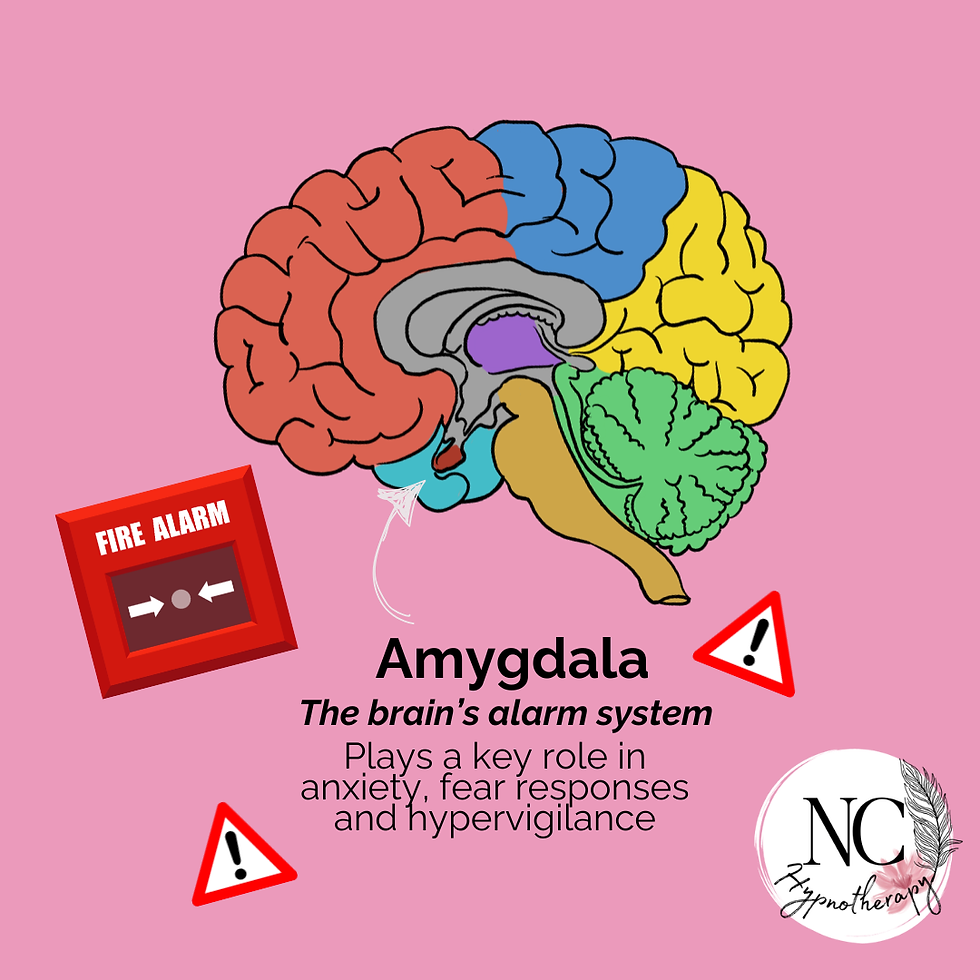
Research using brain imaging has consistently shown that people experiencing anxiety often have increased activity in the amygdala, making it more likely to interpret situations as threatening, even when they're actually safe.
It's the reason why your heart can race before opening an email.
Why your stomach drops when someone says, 'Can we have a chat later?’
If someone hasn’t replied to your text for a a few hours and you've now suddenly convinced yourself that you’ve done something wrong and they hate you.
Or how a headache or pain in your chest has you convinced that it’s a tumour or you're having a heart attack.
Nothing has actually gone wrong. It’s just that your smoke alarm has simply become a little too sensitive and jumping to the worse-case scenario.
The Stress Bucket: Why Anxiety Doesn't Disappear Overnight
If you've worked with me before or been to one of my talks, you'll probably have heard me mention the stress bucket.
For those of you who haven't, imagine you're carrying around a bucket every day.
Every little stress that life throws at you adds to that bucket.
Sometimes those stresses are obvious, like a difficult week at work, financial worries or relationship problems.
But many of them are much smaller and easier to overlook.
Poor sleep. Rushing from one thing to the next. Endless notifications. Traffic. Juggling work, family and everything else life demands.
The only thing that truly empties the bucket is sleep.
While we sleep, our brain processes the day's events, sorts memories and clears away the emotional build-up. It's one of the reasons sleep is so important for our mental wellbeing.
During the day, however, we can help stop the bucket from overflowing by putting a lid on it.
Things like exercise, spending time with people you enjoy, laughing, practising relaxation, getting outside, hobbies and doing things that help you switch off don't empty the bucket, but they do help it from spilling over.
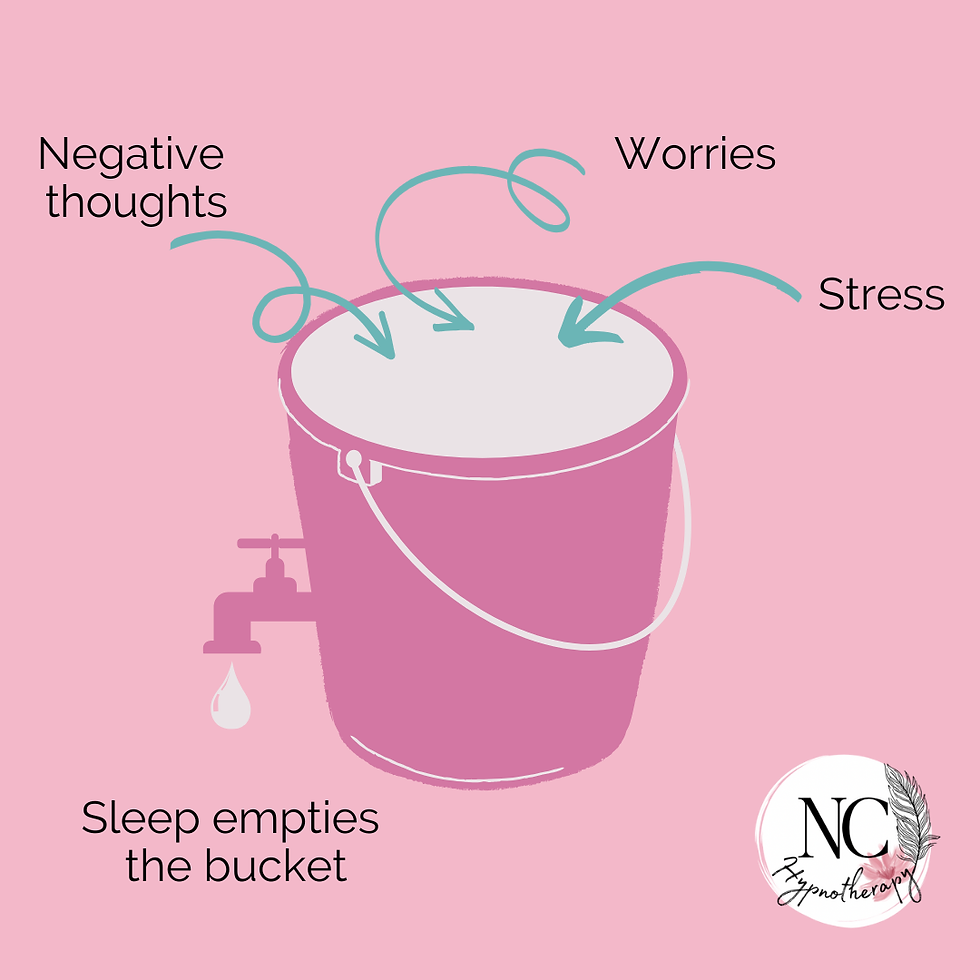
The problem comes when stress keeps being added to the bucket, we're not sleeping well enough to empty it, and we're not doing enough of the things that help keep the lid on.
Eventually, the bucket starts to overflow.
When that happens, your brain becomes much more sensitive to stress.
Little things suddenly feel like big things. Problems seem harder to solve, your mind is quicker to jump to worst-case scenarios and it becomes much more difficult to switch off.
You might notice yourself becoming more emotional, more irritable, struggling to concentrate, overthinking conversations, catastrophising about the future or feeling anxious for no obvious reason.
This is why someone can say, 'My life is actually going really well... so why do I have anxiety!?'
The answer is that it isn't always about what's happening today.
Often, it's the build-up of stress over weeks or months (even years!) that has left your brain and nervous system on high alert.
The encouraging news is that once you understand what's filling your bucket and start protecting your sleep, while making time for those 'lid' activities, you can help your brain settle back into a calmer, more balanced state.
(If you want to learn more about your stress bucket, check out this blog post here).
Why You Can Feel Anxious Even When Life Is Good
One of the things clients often say is:
‘When things are going well… it almost makes me more anxious.'
As strange as it sounds, there's a reason for that too.
Perhaps life hasn't always been this calm. Maybe you've previously experienced:
Burnout
A difficult relationship
Health concerns
Financial struggles
Loss
A particularly stressful period at work
Your nervous system learns from those experiences and it becomes used to scanning for danger.
So when life finally settles down, the smoke alarm doesn't immediately switch off and your nervous system stays on high alert.
Your brain then starts looking for the next problem - not always a big thing, but a combination of small tiny things can add up. This is because being high-alert has become its normal operating mode.
It's a bit like when you’ve been on a treadmill for some time and when you hop off suddenly, you feel a bit weird or disorientated because your brain thinks you’re still on it. Your brain works in a similar way with stress, it still thinks you're on that treadmill of stress and danger.
Why The Brain Loves a Bit of 'What If...?'
Our brains love certainty.
And unfortunately there’s only a few things in life that offer much certainty.
When your stress bucket is overflowing and your amygdala is working overtime, your brain tries to solve uncertainty by worrying.
It asks questions like:
'What if something goes wrong?'
'What if I've missed something?'
'What if I'm getting too comfortable?'
'What if this happiness doesn't last?'
From your brain's perspective, worrying feels useful.
It believes that if it thinks through every possible scenario, it'll somehow protect you.
The irony is that it usually achieves the opposite.
Instead of helping you prepare, it keeps your brain focused on threat.

In fact, research has consistently shown that our brains are surprisingly poor at predicting the future.
In one study, people with Generalised Anxiety Disorder (GAD) found that over 91% of the things they worried about never actually happened. Even when some worries did come true, they often turned out to be less distressing or more manageable than expected.
Yet the brain keeps worrying because it mistakes worrying for problem-solving.
Why It's Hard to Talk Yourself Out of Anxiety
Have you ever found yourself thinking: 'I know I'm being irrational…'
You’ve tried to justify, rationalise and convince yourself that you’re safe and it’ll be ok.
But somehow it doesn’t land and you're not only feeling anxious but also frustrated with yourself for being anxious.
That's because anxiety doesn't start in the thinking part of your brain.
When you're stressed, your body releases cortisol and adrenaline. These chemicals are incredibly useful in genuine emergencies.
However, they also make it harder for your prefrontal cortex (the part of your brain responsible for logic, planning and rational thinking) to do its job.
So the emotional brain (your amygdala) becomes louder.
And your logical brain shuts down.
Which is why you can tell yourself everything is ok, do the research, have people around you reassure you that you're going to be ok …and yet you still feel like it isn't.
This isn't because you're weak or not trying hard enough.
It's because you're human and the survival part of your brain is taking charge.
The Brilliant News: Your Brain Can Change
Just because you feel this way right now - even if you've felt like this for a long time - doesn't mean you have to feel this way forever.
One of my favourite things to explain to clients is that your brain isn't fixed. It's constantly adapting through a process called neuroplasticity.
Every time you calm your nervous system…
Every time you notice what's going well…
Every time you respond differently to anxious thoughts instead of automatically believing them…
…you're helping your brain build and strengthen new neural pathways.
Little by little, your brain begins to realise it doesn't need to stay on high alert all the time.

This isn't about pretending life is perfect (toxic positivity? No thank you!) or trying to force yourself to 'just think positive.' Positive thinking is wonderful when you genuinely believe it, but if your brain is stuck in threat mode, simply telling yourself to 'be positive' rarely works.
Instead, it's about helping your brain recognise that you're safe.
From there, it becomes easier to relax, worry less, feel more confident and, as so many of my clients tell me, feel more like themselves again.
How Solution Focused Hypnotherapy Can Help
This is exactly where Solution Focused Hypnotherapy can make such a difference.
Rather than repeatedly analysing everything that's gone wrong, we focus on helping your brain function differently.
Together, we'll explore how your brain works, reduce the activity of that over-sensitive 'smoke alarm’ and help you empty your stress bucket so your nervous system can settle.
The hypnosis itself allows your brain and body to enter a deeply relaxed state, giving your mind an opportunity to consolidate learning, strengthen healthier neural pathways and spend less time stuck in fight or flight.
As the weeks go by, many clients notice that they're:
Overthinking less.
Sleeping better.
Feeling calmer.
Worrying less about the future.
Enjoying the present more.
Feeling more like themselves again.
Not because life has suddenly become perfect but because their brain no longer feels the need to constantly scan for danger.
You Don't Need a 'Good Enough' Reason to Feel Anxious
If you've ever found yourself thinking:
'I should be grateful.'
'I've got no reason to feel like this.'
'Other people have it much worse.'
Remember this:
Anxiety isn't a measure of how good or bad your life is.
Your brain doesn't compare your struggles with anyone else's. It simply responds to what it believes will keep you safe.
Understanding that can be the first step towards letting go of the guilt that so often comes with anxiety.
If you can take one thing away from reading this, I hope it's this...
Feeling anxious doesn't automatically mean something is wrong with your life.
Often, it's simply a sign that your brain has become a little too good at trying to protect you.
The wonderful thing is that our brains are remarkably adaptable. Once you understand why anxiety happens and begin supporting your brain in a different way, things really can begin to change.
If you've recognised yourself in what you've read today, know that you don't have to keep living in a cycle of worrying and catastrophising. Change is possible, and the first step is often understanding what's happening inside your brain. Because once you understand it, you can begin to move towards feeling calmer and more like yourself again.

Looking for Help with Anxiety in Essex or Online?
If you've recognised yourself in this blog, know that anxiety doesn't have to be your 'normal.'
As a Clinical Hypnotherapist and Psychotherapist based in Hatfield Peverel, Essex, I specialise in helping people overcome anxiety, overthinking, catastrophising and overwhelm using Solution Focused Hypnotherapy.
I work with clients from Brentwood, Chelmsford, Maldon, Witham, Colchester and the surrounding areas, as well as online across the UK and worldwide.
The first step is simply arranging a free, no-obligation telephone call. It's an opportunity to tell me a little about what's been going on, ask any questions you have, and find out how Solution Focused Hypnotherapy could help. There's no pressure to book sessions afterwards - it's simply a chance for us to see whether I'm the right person to support you.


Comments